The UK judiciary
A walk through the whole topic. What the courts do, how the Supreme Court was built in 2009, what judicial independence and neutrality actually mean, the cases that test them, and the question behind every 30-mark essay: has the judiciary become too powerful, or is it just doing its job?
The UK has a judiciary built almost entirely in living memory. The Supreme Court is younger than most students sitting Paper 2; the Human Rights Act, the Constitutional Reform Act and the Lord Chief Justice as head of the judiciary all date from 1998-2005. Yet the questions the courts now answer - whether a government can prorogue Parliament, whether prisoners can vote, whether a Rwanda removal scheme is lawful - reach the heart of the constitution. This walk-through takes the topic in order: what the judiciary is, what it does, the cases that built its modern powers, the two pillars (independence and neutrality), and the central debate about its proper relationship with Parliament.
What the judiciary is, and the words to use
The terms the examiner expects, before any case is named.
The judiciary is the branch of state that interprets and applies the law. In the UK, the most senior court is the UK Supreme Court, created by the Constitutional Reform Act 2005 and opened on 1 October 2009. It replaced the Appellate Committee of the House of Lords, deliberately separating the senior judges from the legislature. There are twelve Justices of the Supreme Court; most appeals are heard by panels of five; the most constitutionally significant cases go to nine or eleven.
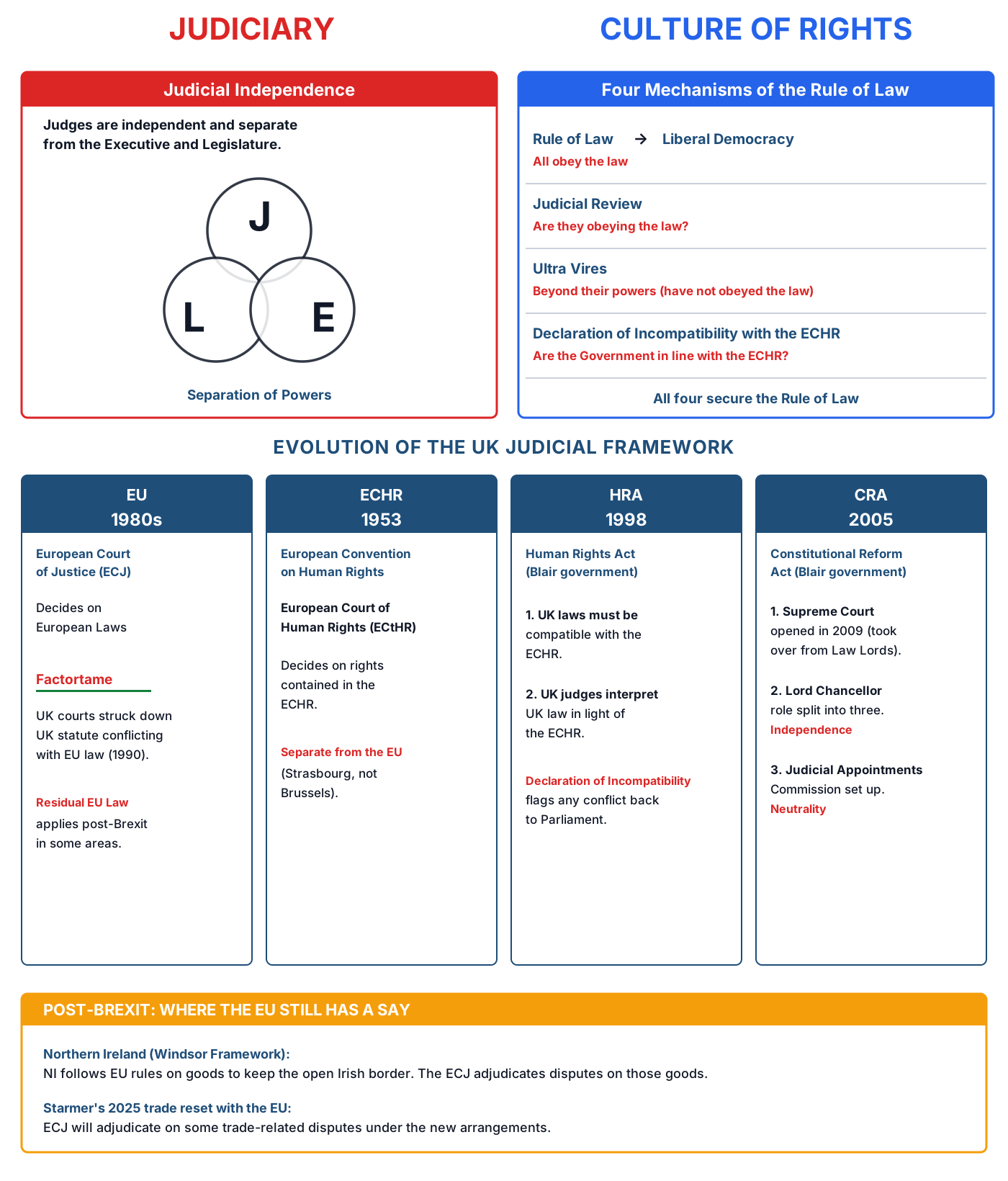
Two principles run through every essay on the topic. Judicial independence means judges decide cases free from external pressure - in particular from the executive. It is protected in the UK by security of tenure (judges cannot be removed except by an address of both Houses of Parliament), guaranteed salaries paid from the Consolidated Fund, the independent Judicial Appointments Commission created by the 2005 Act, and the convention that ministers do not comment publicly on individual cases. Judicial neutrality is different - it is the expectation that judges decide each case on the law alone, without personal political views shaping the outcome. Independence is mostly about the relationship with other institutions; neutrality is mostly about the individual judge.
Judicial review is the route by which the courts hold the executive to account: a court reviewing whether a minister or public body has acted within the powers Parliament gave it. A decision found to exceed those powers is held to be ultra vires and quashed. The growth of judicial review since the 1960s, and the post-1998 layer added by the Human Rights Act, is the topic's central institutional change.
A third pair of terms runs alongside independence and neutrality, and the strongest essays use them as a recurring analytical theory. Judicial activism describes a willingness to give a wide reading to statutes, to push at the boundaries of judicial review, and to assert constitutional limits on the executive even where the precedents do not clearly require it. Judicial restraint is the opposite disposition: a preference for narrow rulings, deference to Parliament's choices on matters of policy, and reluctance to enter politically contested terrain. Activism and restraint are judicial dispositions, not formal powers; an activist Court does not have more authority than a restrained one, but it exercises what authority it has more boldly. The Hale-era Supreme Court (2017-2020) is generally read by constitutional commentators as activist; the Reed-era Court (2020-) is widely described as more restrained. That contrast is the spine of any contemporary essay on judicial power.
Part 1 in one picture: independence, the four mechanisms of the rule of law, the framework that built it, and where the EU still has a say.
What the courts actually do
Five roles, each with a different relationship to Parliament. Scroll - each lights up in turn.
The courts do not just settle private disputes. They have five distinct constitutional roles, each with its own relationship to Parliament. The diagram beside you holds them.
Five distinct roles
The senior judiciary does five things at constitutional level: judicial review of executive action, interpretation of statute, development of the common law, enforcement of the Human Rights Act, and conduct of public inquiries. Each carries a different degree of friction with Parliament. Scroll through them in turn.
Judicial review of executive action
The single most important power. The courts examine whether a minister or public body has acted within the legal powers given to them by Parliament, on rational grounds, and through fair procedure. If the answer is no, the decision is held to be ultra vires and quashed. Miller 1 (2017) ruled that the government could not trigger Article 50 by prerogative alone - Parliament had to legislate. Miller 2 (2019) ruled that Boris Johnson's prorogation of Parliament for five weeks was unlawful, "void and of no effect". R (AAA) v Home Secretary (Nov 2023) ruled the Rwanda removal scheme unlawful as Rwanda was not a safe third country. Judicial review is the central battleground between courts and executive.
Statutory interpretation
When Parliament passes a statute, the courts decide what it means in any case where it applies. Most statutory interpretation is uncontroversial - what Parliament intended, read in context. But hard cases force the courts to fill in gaps Parliament did not anticipate, and the choice of interpretive principle (literal, purposive, mischief) can shape the law as much as the words on the page. Section 3 of the Human Rights Act 1998 explicitly requires courts to read legislation "so far as it is possible" in a way that is compatible with Convention rights - a much stronger interpretive duty than existed before 1998.
The common law
Outside areas covered by statute, the courts develop the law through precedent. The doctrine of stare decisis binds lower courts to higher-court rulings and creates a body of judge-made law on negligence, contract, criminal liability, and much else besides. The Supreme Court can depart from its own earlier decisions, but does so rarely. In areas where Parliament has not legislated, the courts effectively make the law through precedent - this is where the activism-restraint distinction matters most: an activist Court will fill the gap boldly; a restrained Court will leave it for Parliament. The boundary between common-law development and effective legislation by judges is one place the "too powerful" critique lands, and where Parliament always has the power, in principle, to legislate over the courts.
Enforcing the Human Rights Act
Since the Human Rights Act 1998 incorporated the European Convention into UK law, courts have a duty to apply Convention rights to every case where they are engaged. Section 3 requires compatible interpretation where possible; Section 4 allows a declaration of incompatibility where it is not. The courts cannot strike down an Act of Parliament - parliamentary sovereignty survives - but a declaration is a strong political signal that Parliament must respond to. A v Secretary of State (Belmarsh, 2004) declared the indefinite detention of foreign nationals incompatible with Article 5; Parliament replaced the regime within a year.
Public inquiries
Judges are often appointed to lead inquiries into matters of public concern - Saville on Bloody Sunday, Leveson on the press, Brook on Grenfell. These are non-judicial in form but draw on the perceived independence and forensic capacity of the senior judiciary. They are politically powerful because the public trusts them, and because their findings shape legislation and ministerial accountability that the parliamentary process alone struggles to deliver.
Five roles, one underlying question
Each role places the judiciary somewhere along the line that runs from interpreter of Parliament's will at one end to independent constitutional actor at the other. Judicial review and HRA enforcement sit towards the second end; statutory interpretation and common law somewhere in the middle. Public inquiries sit outside the strict legal role altogether. A strong essay says which role it is talking about before evaluating power.
From the Bill of Rights to Rwanda
The acts and cases that built the modern UK judiciary. Scroll the timeline beside you.
The modern UK judiciary is the product of two great waves of statute (1998 and 2005) and a run of cases that have tested the new architecture. The timeline beside you maps both.
Old constitution, new architecture
The 1689 Bill of Rights and the 1701 Act of Settlement set the long foundations: parliamentary sovereignty, judicial security of tenure. The modern apparatus is much newer - a 1998 rights revolution, a 2005 structural reform, and a run of headline cases since 2017 that have tested both. Scroll the milestones.
1689 and 1701: the long foundations
The Bill of Rights 1689 settled parliamentary sovereignty after the Glorious Revolution. The Act of Settlement 1701 gave judges security of tenure: they hold office "during good behaviour", removable only by an address of both Houses of Parliament. These two statutes are the deep foundation of judicial independence in the UK constitution.
1998: the Human Rights Act
The Human Rights Act 1998, in force 2 October 2000, incorporated the European Convention on Human Rights into UK law. Sections 3 and 4 created the interpretive duty and the declaration of incompatibility. Section 6 made it unlawful for public authorities to act incompatibly with Convention rights. Without the HRA the modern role of UK courts is barely intelligible; almost every headline case since rests on rights it brought home.
2005: the Constitutional Reform Act
The Constitutional Reform Act 2005 redrew the institutional architecture. It created the UK Supreme Court (opened October 2009), stripped the judicial role from the Lord Chancellor (who had been head of judiciary, speaker of the Lords and a Cabinet minister at once), created the independent Judicial Appointments Commission, and made the Lord Chief Justice the head of the judiciary of England and Wales. The Act is the structural breakthrough: separation of powers, finally, on paper.
2005-12: the Strasbourg edge
The HRA brought rights home, but the Strasbourg court still bound the UK at international level. Hirst v UK (2005) ruled the UK's blanket ban on prisoner voting breached Article 3 of Protocol 1. The UK never implemented the ruling beyond minimal compliance. Abu Qatada (UK and Strasbourg, 2008-13) tested whether the UK could deport on diplomatic assurances. Both cases stoked the political argument that has run ever since: is the rights architecture itself too strong?
2017-19: the Miller cases
Miller 1 (Jan 2017) ruled 8-3 that the government could not trigger Article 50 by prerogative alone - Parliament had to legislate. Miller 2 (Sept 2019), with Lady Hale presiding, ruled unanimously 11-0 that Boris Johnson's five-week prorogation of Parliament was unlawful, "void and of no effect". The two cases mark the moment the Supreme Court openly read the constitution as constraining executive power. The Daily Mail's "Enemies of the People" front page (Nov 2016) marked the moment the politics of that role turned hostile.
2023: the Rwanda judgment
In November 2023 the Supreme Court ruled unanimously in R (AAA) v Secretary of State for the Home Department that the UK government's Rwanda removal scheme was unlawful: Rwanda was not, on the evidence, a safe third country. The Sunak government responded with the Safety of Rwanda (Asylum and Immigration) Act 2024, attempting to legislate Rwanda's safety. The case is the cleanest contemporary example of the courts checking executive action and Parliament responding by trying to remove the check.
2024-27: the Reed era ends
Lord Reed, President of the Supreme Court since January 2020, announced in January 2026 that he would retire in January 2027. A selection commission was launched in spring 2026. The Reed-era Court has been notably more cautious about expanding the constitutional role than the Hale-era Court that delivered Miller 2. Who succeeds him is one of the most consequential public-law questions of the next twelve months.
Architecture built; politics unresolved
The 1998-2005 architecture is settled. The political question - whether the courts have too much power, whether the HRA needs replacing, whether judicial review needs curbing - has not stopped moving since. Successive Conservative governments tabled Bill of Rights proposals (Cameron, Truss, Sunak) that were repeatedly shelved. The Labour government from July 2024 has reaffirmed the HRA. The architecture has held; the politics around it has not.
Independence against neutrality
The two pillars examiners want named, separated and tested.
Independence and neutrality are different things, and the strongest essays separate them. Independence is institutional: the courts shielded from external pressure. Neutrality is individual: judges deciding on the law, not on personal politics. The diagram beside you sets the two side by side.
Two different things
Independence and neutrality are often conflated in answers, but the exam wants them held apart. Independence is the relationship of the judiciary as an institution to the executive and the legislature. Neutrality is the relationship of an individual judge to the law in a particular case. The diagram beside you sets them out. Scroll through each in turn.
Independence: the institutional case
UK judges are independent in four formal ways. Security of tenure (Act of Settlement 1701) - judges hold office during good behaviour, removable only by an address of both Houses. Guaranteed salaries paid from the Consolidated Fund, immune to political adjustment. Independent appointment through the Judicial Appointments Commission (CRA 2005), replacing the old system where the Lord Chancellor effectively chose. Convention against ministerial criticism of individual judges or cases - a convention strained by the Daily Mail's 2016 "Enemies of the People" front page and by ministerial comments on Strasbourg rulings.
Independence: the strains
The formal protections are strong; the political pressure is real. Successive Home Secretaries have publicly criticised the courts after asylum and deportation rulings. Conservative manifestos from 2015 onwards proposed replacing the HRA. Liz Truss as Lord Chancellor was widely criticised in 2016 for failing to defend the judges attacked over Miller 1. The current Court has been notably more cautious about constitutional confrontation post-Miller 2. Independence does not mean immunity from politics; it means the formal architecture survives the politics. By that test, it has.
Neutrality: the case for
The case for judicial neutrality rests on the appointment process and the professional norms of the bench. The JAC selects on merit through an independent process. Senior judges are barristers with long careers spent advocating both sides of cases. They are required not to be members of political parties or to engage in political campaigning. The convention is that they decide on the law - statute and precedent - and not on personal preference. Where personal views are known, judges recuse themselves.
Neutrality: the case against
The standard critique is that the senior bench is socially narrow, and that this shapes outcomes whatever the formal commitment to neutrality. J A G Griffith's "The Politics of the Judiciary" (1977) made the case in classic form. The current statistics give it modern force. The UK Supreme Court of 2025 sits at 8% female (two Justices out of twelve - Lady Rose and Lady Simler) - tied with Pakistan for the lowest proportion of female justices among comparable common-law supreme courts. The Court has never appointed a Justice of colour in its sixteen years. Around 70% of senior judges are Oxbridge-educated and the great majority are former barristers in commercial chambers. By comparison Canada has two Justices of colour out of nine; the US three out of nine; New Zealand's Supreme Court is around 50% women. The contemporary version of the critique adds that judicial review now reaches areas - immigration, asylum, Brexit - where any decision has political consequences regardless of judicial intent.
Two pillars, one verdict
On independence, the UK judiciary is unusually well protected by comparative standards - formally and in practice. On neutrality, the formal commitment is strong but the social composition of the bench remains a real critique. A strong essay holds the two apart and reaches different verdicts on each. "The Supreme Court is too political" usually means a worry about neutrality, dressed up as a complaint about independence; the strongest answers say so.
The Court against Parliament
The central comparative axis of every 30-mark question on the topic.
Almost every Paper 2 essay on the judiciary is, at root, a question about the proper balance between unelected judges and elected legislators. Set the two against each other and the contemporary debate becomes legible.
The axis the exam tests
The 30-mark questions in this topic almost all test the comparative axis: courts against Parliament. The Supreme Court reviews executive action and interprets statute; Parliament makes the law and can, in principle, override the Court. The relationship is not stable. Scroll through the four dimensions of the contemporary argument.
Reach - how far courts go now
The judicial reach is wider than it was. Judicial review has grown from a niche administrative remedy in the 1960s to a routine constraint on government today. The HRA brought rights review into every public-law case. Miller 1 and 2 brought the courts into the central constitutional questions. R (AAA) Rwanda (2023) stopped a flagship government policy. Defenders say the courts are doing what Parliament asked them to do - applying the law as it stands. Critics say judicial review now reaches questions the courts were not designed for. Interim judgement: the reach has grown; whether that is overreach depends on whether you think the underlying statutes are doing the work.
Sovereignty - which side has the last word?
On the formal question, Parliament still wins. The courts cannot strike down an Act of Parliament. The strongest tool the HRA gives them - a declaration of incompatibility - leaves the statute on the books. The Safety of Rwanda Act 2024 demonstrated that Parliament can legislate against a court ruling. But the courts can constrain in practice in ways the formal rule does not capture: declarations carry political weight; quashed executive action is gone; common-law principles bind. Interim judgement: parliamentary sovereignty survives in form; in practice the courts now make much of the running.
Rights - courts as guarantors, or Parliament?
Defenders of an active judicial role argue that rights need protection from electoral majorities that may turn against them - the standard liberal-constitutional case. The HRA, the Belmarsh declaration, the Rwanda ruling are all examples. Critics reply that rights protection should be the democratic decision of Parliament, not the policy decision of unelected judges - and that elected politicians are answerable to voters in a way that judges are not. The Bill of Rights debate (Cameron, Truss, Sunak proposals) sits exactly on this axis. Interim judgement: depends entirely on which test of legitimacy you apply - democratic accountability or rights protection.
Activism against restraint - the Hale-Reed contrast
The contemporary debate about whether the Court has become "too political" is best read through the activism-restraint pairing. The Hale-era Court is widely characterised by constitutional commentators as activist: Miller 2 (2019) asserted constitutional limits on the prerogative power to prorogue; the Belmarsh declaration of incompatibility in 2004 pushed the HRA's reach to its limit. The Reed-era Court is widely described as more restrained: R (Begum) (2021) upheld the Home Secretary's deprivation of citizenship on national-security grounds; the Rwanda case in 2023 ruled the scheme unlawful on the narrow factual ground that Rwanda was not a safe third country, rather than on broader rights principles. Constitutional scholars including Mark Elliott and others have argued that the institution self-regulates in response to political pressure - the formal protections of independence have held, but the disposition of the Court has adjusted. Interim judgement: politicised in subject matter, not in conduct; the Daily Mail "Enemies of the People" headline did not bend the judges, and the Reed Court has chosen restraint without surrendering function.
The verdict to carry into the exam
Parliamentary sovereignty survives; the courts now constrain in practice more than they used to; rights protection is the central battleground; the Court has not lost its independence under political pressure but has trimmed its constitutional ambition. The proper essay verdict is a balanced one - the architecture is sustainable, the politics around it is not.
Into the exam
The questions this topic produces and the three-theme comparative structure that answers them.
Paper 2 examines this topic primarily as a 30-mark essay. The questions below reflect recent Edexcel forms.
30Evaluate the view that the UK Supreme Court has become too powerful.
Trap: "too powerful" against what test? Three comparative themes work: reach against parliamentary sovereignty (Miller cases against the Safety of Rwanda Act); rights protection against democratic accountability (HRA architecture against elected-government legitimacy); Hale-era Court against Reed-era Court (institutional ambition has actually narrowed, not grown). Reach a balanced verdict that distinguishes reach from power.
30Evaluate the view that the UK Supreme Court is sufficiently independent.
Trap: independence as institutional against neutrality as individual - hold them apart. Three themes: formal protections (security of tenure, salary, JAC, CRA 2005) against ministerial criticism in practice; the Miller cases as the test under fire; social composition of the bench (Griffith critique) against the formal apparatus. Argue independence is well-protected; neutrality is the contested term.
30Evaluate the view that the Human Rights Act should be replaced.
Trap: compare the HRA on the books against the Conservative Bill of Rights proposals against the Labour position post-2024. Themes: HRA reach (Belmarsh, Hirst) against parliamentary sovereignty as the limit; UK courts against Strasbourg as the binding authority; rights protection now against rights protection under a successor regime.
30Evaluate the view that judicial review needs reform.
Trap: "needs reform" - in which direction? Themes: judicial review's growth since the 1960s against original administrative scope; recent rulings (Miller 2, Rwanda) against the executive function; the IRAL (Faulks) review 2021 recommendations against the case for the status quo.
One essay, worked through
Three directly comparative themes - each pits the affirmative against the counter on a single dimension, so AO3 evaluation interweaves throughout.
- Theme 1, reach against power - has the Court done more, or been given more? Reach has grown: Miller 1 (2017), Miller 2 (2019), R (AAA) Rwanda (2023) all bring the Court into central constitutional questions. Power has not: the HRA gives only declarations, not strike-down; the Safety of Rwanda Act 2024 showed Parliament can override. Interim judgement: reach is greater, formal power is not.
- Theme 2, courts as rights guarantor against Parliament as democratic legislator. Defenders: rights need protection from electoral majorities (Belmarsh 2004 declaration; Hirst v UK 2005). Critics: rights protection should be Parliament's choice (Bill of Rights proposals 2014-2022). Interim judgement: the question is normative; on the UK constitution as it stands, the Court is doing what Parliament instructed via the HRA - the architecture is the will of Parliament.
- Theme 3, judicial activism against judicial restraint - the Hale-Reed contrast. The Hale-era Court is widely characterised as activist: Miller 2 (11-0, prorogation void); Belmarsh-style declarations of incompatibility. The Reed-era Court is widely characterised as restrained: R (Begum) 2021 (citizenship deprivation upheld); the Rwanda 2023 ruling on narrow factual grounds (Rwanda's safety, not the scheme's principle). Interim judgement: if the institution were genuinely too powerful, the most recent rulings would push further; instead the Reed Court has chosen restraint. The choice between activism and restraint is the Court's own; the institution self-regulates without losing its formal independence.
- Conclusion: the Court's reach has grown, but its formal power has not. The cases that look like overreach are cases where the courts applied statutes Parliament passed. The contemporary Court is more cautious than the Hale Court, suggesting the institution self-regulates. The claim "too powerful" cannot stand on the architecture as it is.
Other comparative themes you could substitute: formal independence against political pressure (CRA 2005 protections against "Enemies of the People" and ministerial criticism); HRA against Strasbourg (the bring-rights-home logic against the binding authority of the ECtHR); judicial activism against judicial restraint (Hale doctrine against Reed doctrine); rights of the individual against rights of the elected majority (the Griffith critique reframed).
Practise this topic
You have walked the topic. Now check your recall and structure your answers.
Key terms
The vocabulary the examiner expects you to define and use.
Open the glossary
Judiciary - the branch of state that interprets and applies the law.
UK Supreme Court - the most senior court in the UK; created by the CRA 2005, opened 1 October 2009; 12 Justices.
Judicial independence - the institutional protection of judges from external pressure, secured by security of tenure (Act of Settlement 1701), guaranteed salaries, the JAC and convention against ministerial criticism.
Judicial neutrality - the expectation that individual judges decide on the law alone, without personal political views shaping the outcome.
Judicial activism - a judicial disposition that gives statutes wide readings, pushes at the boundaries of judicial review, and asserts constitutional limits on the executive even where precedent does not clearly require it. The Hale-era Supreme Court (2017-2020) is widely read as activist. Not a formal power but a way of using existing powers.
Judicial restraint - the opposite disposition: narrow rulings, deference to Parliament's policy choices, reluctance to enter contested political terrain. The Reed-era Supreme Court (2020-) is widely read as more restrained.
Judicial review - the route by which courts examine whether public bodies have acted within their legal powers (illegality), on rational grounds (irrationality) and through fair procedure.
Ultra vires - "beyond the powers"; the ground for quashing executive action that exceeds what Parliament authorised.
Parliamentary sovereignty - the constitutional principle that Parliament can make or unmake any law and that no other body, including the courts, can override an Act of Parliament.
Constitutional Reform Act 2005 - the statute that created the Supreme Court, the Judicial Appointments Commission, and reformed the Lord Chancellor's role.
Human Rights Act 1998 - the statute that incorporated the European Convention on Human Rights into UK law. Section 3 requires compatible interpretation; Section 4 allows a declaration of incompatibility; Section 6 makes it unlawful for public authorities to act incompatibly.
Declaration of incompatibility - the strongest tool the HRA gives the courts in relation to primary legislation; it flags incompatibility but does not strike the Act down. Parliament must decide whether to respond.
European Court of Human Rights (ECHR / Strasbourg) - the court of the Council of Europe (not the EU); binds the UK at international level on Convention rights.
Miller 1 (R (Miller) v Secretary of State for Exiting the EU, 2017) - 8-3: Article 50 cannot be triggered by prerogative; Parliament must legislate.
Miller 2 (R (Miller) v The Prime Minister, 2019) - 11-0: Boris Johnson's prorogation of Parliament for five weeks was unlawful, "void and of no effect".
R (AAA) v Home Secretary (2023) - the Supreme Court ruled the Rwanda removal scheme unlawful as Rwanda was not a safe third country.
Bill of Rights debate - the recurring Conservative proposal to replace the HRA with a domestic Bill of Rights, repeatedly proposed (Cameron 2014, Truss 2022, Sunak 2023) and repeatedly shelved.
Lord Reed - President of the Supreme Court since January 2020; announced retirement effective January 2027; succeeded Lady Hale.
Lady Hale (Brenda Hale) - first woman President of the Supreme Court, 2017-2020; delivered the Miller 2 judgment.
Judicial Appointments Commission (JAC) - independent body created by the CRA 2005 to select judicial candidates on merit.