The UK judiciary · Notes
About these notes. This is the sub-topic lookup version of the topic. For the narrative lesson, use the Walk-through; for active recall, use the MCQ Quiz. The cards below open one at a time and cover everything Paper 2 expects you to know on the UK judiciary.
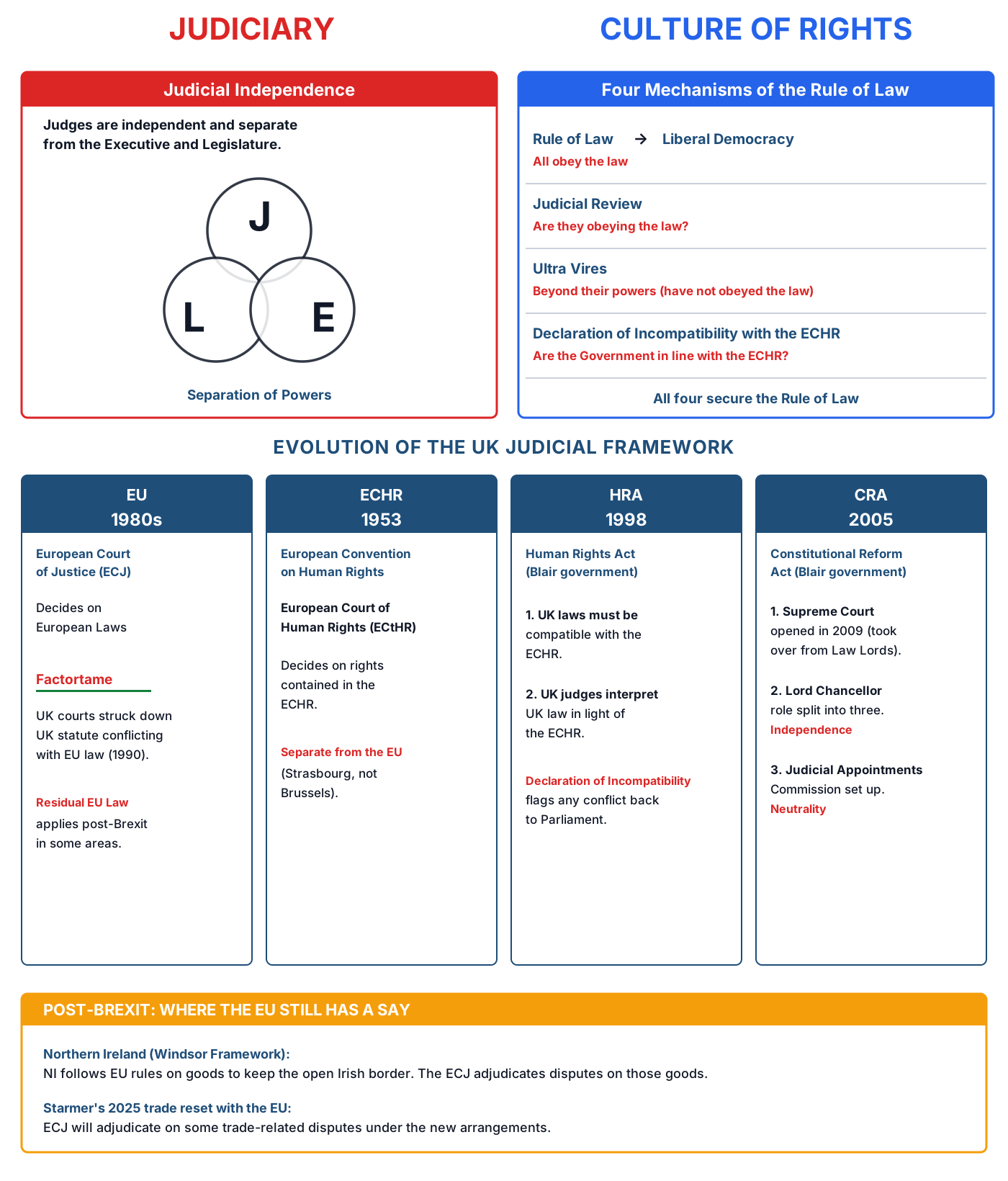
Topic overview diagram
One picture to anchor everything: judicial independence (the J/L/E separation), the four mechanisms of the rule of law, the historical framework (EU, ECHR, HRA, CRA 2005), and where the EU still has a say post-Brexit.
1. What "the judiciary" is, and the words to use
The judiciary is the branch of state that interprets and applies the law. The most senior court is the UK Supreme Court, created by the Constitutional Reform Act 2005 and opened on 1 October 2009. It has twelve Justices.
Three pairs of terms to keep separate
- Independence against neutrality. Independence is institutional - the courts shielded from external pressure. Neutrality is individual - judges deciding on the law alone, not on personal politics.
- Activism against restraint. Dispositions, not powers. An activist Court gives statutes wide readings and pushes at the boundaries of judicial review; a restrained Court rules narrowly and defers to Parliament.
- Judicial review against parliamentary sovereignty. Judicial review is the courts checking executive action; parliamentary sovereignty is the constitutional principle that Parliament can make or unmake any law.
Other key terms
- Ultra vires - "beyond the powers"; ground for quashing executive action that exceeds Parliament's authorisation.
- Declaration of incompatibility - the strongest tool the HRA gives the courts; flags an Act as incompatible with the Convention but cannot strike it down.
- Stare decisis - the principle of following past precedent; binds lower courts to higher-court rulings.
2. The Supreme Court - composition and how it was built
Composition and process
- Twelve Justices. Most appeals heard by panels of five; constitutional cases go to nine or eleven.
- President: Lord Reed since January 2020; announced retirement effective January 2027. Selection commission running in 2026 to find his successor.
- Predecessor: Lady Hale (Brenda Hale) - first woman President, 2017-2020.
- Appointments: through the Judicial Appointments Commission, created by the Constitutional Reform Act 2005. Merit-based, independent selection.
Where it sits in the constitution
The Supreme Court is the apex appellate court for civil cases across the UK and for criminal cases in England, Wales and Northern Ireland (Scottish criminal appeals go to the High Court of Justiciary). It does NOT strike down Acts of Parliament - parliamentary sovereignty survives.
3. The Constitutional Reform Act 2005
The structural reform that built the modern UK judiciary.
What it did
- Created the UK Supreme Court (opened 1 October 2009), replacing the Appellate Committee of the House of Lords.
- Created the Judicial Appointments Commission, ending the system where the Lord Chancellor effectively chose senior judges.
- Stripped the judicial role from the Lord Chancellor, who before 2005 had been head of judiciary, Speaker of the House of Lords AND a Cabinet minister all at once. The Lord Chief Justice became head of the judiciary of England and Wales.
- Reformed the route into the senior judiciary, including the JAC's merit-selection process.
4. The Human Rights Act 1998 and the ECHR
The 1998 statute that incorporated the European Convention on Human Rights into UK law. In force 2 October 2000.
How it works
- Section 3: requires courts to read legislation, so far as possible, in a way compatible with Convention rights.
- Section 4: where compatible reading is not possible, courts can issue a declaration of incompatibility. The Act stays on the statute book; Parliament decides whether to respond. The Court CANNOT strike statute down.
- Section 6: makes it unlawful for public authorities to act incompatibly with Convention rights.
The Strasbourg layer
The European Court of Human Rights in Strasbourg sits above UK courts at international level. It is part of the Council of Europe, NOT the European Union - Brexit did not remove the UK from the Convention. The UK is bound by Strasbourg rulings as a matter of international law, though enforcement depends on domestic compliance.
Bill of Rights debate
Successive Conservative governments proposed replacing the HRA with a domestic Bill of Rights - Cameron 2014, Truss 2022, Sunak 2023. Each proposal was shelved. The Labour government from July 2024 has reaffirmed the HRA. Likely to remain a contested area in any future Conservative government.
5. Judicial independence - the institutional case
The institutional protection of judges from external pressure.
Four formal protections
- Security of tenure. Act of Settlement 1701 - judges hold office "during good behaviour", removable only by an address of both Houses of Parliament. Has never been used in modern times.
- Guaranteed salaries. Paid from the Consolidated Fund, not subject to year-by-year political adjustment.
- Independent appointment. The Judicial Appointments Commission (CRA 2005) selects on merit through an independent process. Before 2005 the Lord Chancellor effectively chose.
- Convention against ministerial criticism. Ministers do not comment publicly on individual cases or judges. The convention is strained but holds.
Strains on independence
- The Daily Mail's "Enemies of the People" front page (November 2016) after the Miller 1 ruling - the most direct attack on judges in modern times.
- Liz Truss as Lord Chancellor was widely criticised in 2016 for failing to defend the judges over Miller 1.
- Successive Home Secretaries have publicly criticised the courts after asylum and deportation rulings.
- Bill of Rights reform proposals throughout the 2014-2022 period.
6. Judicial neutrality - the case for and against
The expectation that individual judges decide cases on the law alone, not on personal political views.
The case for neutrality
- JAC selects on merit through an independent process.
- Senior judges are career barristers who have advocated both sides of cases.
- Judges are required not to be members of political parties or to engage in political campaigning.
- Convention is to decide on statute and precedent; judges recuse themselves where personal views are known.
The Griffith critique - and the modern statistics
J A G Griffith's "The Politics of the Judiciary" (1977) made the classic case that the senior bench was too socially narrow for neutrality to be credible. The current statistics give the critique modern force:
- 8% female in the UK Supreme Court 2025 - two Justices out of twelve (Lady Rose, Lady Simler). Tied with Pakistan for the lowest proportion among comparable common-law supreme courts.
- Zero ethnic-minority Justices appointed to the UK Supreme Court in its sixteen years.
- Around 70% of senior judges Oxbridge-educated; majority are former barristers in commercial chambers.
- By comparison: Canada Supreme Court 2/9 Justices of colour; US Supreme Court 3/9; New Zealand around 50% women.
The contemporary version of the critique
Judicial review now reaches areas - immigration, asylum, Brexit - where any decision has political consequences regardless of judicial intent. Even on the most formal reading of neutrality, the political LANDSCAPE of judging has changed.
7. Judicial activism against judicial restraint
The third analytical pair that runs alongside independence and neutrality. These are dispositions, not formal powers - an activist Court does not have more authority than a restrained one, but it uses what authority it has more boldly.
Judicial activism
A willingness to give statutes wide readings, push at the boundaries of judicial review, and assert constitutional limits on the executive even where precedent does not clearly require it. Indicators: bold declarations of incompatibility, broad readings of HRA Section 3, willingness to enter politically contested terrain.
- Hale-era Court (2017-2020) is widely characterised by constitutional commentators as activist.
- Belmarsh declaration (2004): pushed the HRA to its limit on a national-security policy.
- Miller 2 (2019): asserted constitutional limits on the prerogative power to prorogue. 11-0.
Judicial restraint
The opposite disposition: a preference for narrow rulings, deference to Parliament's policy choices, and reluctance to enter politically contested terrain.
- Reed-era Court (2020-) is widely characterised as more restrained.
- R (Begum) (2021): upheld the Home Secretary's deprivation of citizenship on national-security grounds - narrow, deferential.
- Rwanda (2023): ruled the scheme unlawful, but on the narrow factual ground that Rwanda was not a safe third country, rather than on broader rights principles.
8. Landmark cases - in chronological order
The cases the examiner expects you to be able to cite, with dates and holdings. Chronology matters - the 2025 P3 USA ER warned against chronological confusion and the same warning applies here.
| Year | Case | What it decided / why it matters |
|---|---|---|
| 1689 | Bill of Rights | Settled parliamentary sovereignty after the Glorious Revolution. |
| 1701 | Act of Settlement | Judicial security of tenure - removable only by an address of both Houses. |
| 1998 | Human Rights Act | Incorporated ECHR into UK law (in force 2000). Sections 3 and 4 create the modern rights role. |
| 2004 | A v Secretary of State for the Home Department (Belmarsh) | Declaration of incompatibility: indefinite detention of foreign nationals incompatible with HRA Article 5. Parliament replaced the regime. |
| 2005 | Hirst v UK (ECtHR) | Strasbourg ruled UK's blanket ban on prisoner voting incompatible with Convention. UK has never fully implemented. |
| 2005 | Constitutional Reform Act | Created the Supreme Court, JAC; reformed the Lord Chancellor's role. |
| 2009 | UK Supreme Court opens | 1 October. Replaces the Appellate Committee of the House of Lords. |
| 2017 | R (Miller) v Secretary of State for Exiting the EU (Miller 1) | 8-3: Article 50 cannot be triggered by prerogative; Parliament must legislate. |
| 2019 | R (Miller) v The Prime Minister (Miller 2 / Cherry) | 11-0: Boris Johnson's prorogation of Parliament for five weeks was unlawful, "void and of no effect". Lady Hale presiding. |
| 2020 | Lord Reed succeeds Lady Hale | Era shift from activist (Hale) to restrained (Reed). |
| 2021 | R (Begum) v Home Secretary | Reed-era restraint: citizenship deprivation on national-security grounds upheld. |
| 2023 | R (AAA) v Home Secretary (Rwanda) | Unanimous: the Rwanda removal scheme was unlawful as Rwanda was not a safe third country. Decided on narrow factual grounds. |
| 2024 | Safety of Rwanda (Asylum and Immigration) Act | Parliament's response: legislated Rwanda's safety. The clearest contemporary example of Parliament overriding a Court ruling. |
| 2026 | Lord Reed retirement announced | Retiring January 2027; selection commission for next President running. |
9. The courts against Parliament - the central debate
The comparative axis behind almost every 30-mark question in this topic.
Four dimensions of the contemporary argument
- Reach. Judicial review has grown from a niche administrative remedy in the 1960s to a routine constraint on government today. The HRA brought rights review into every public-law case. Miller 1 and 2 brought the courts into central constitutional questions. Rwanda 2023 stopped a flagship government policy. The reach is wider than it was.
- Sovereignty. On the formal question, Parliament still wins. The courts cannot strike down an Act of Parliament. A declaration of incompatibility leaves the statute on the books. The Safety of Rwanda Act 2024 demonstrated that Parliament can legislate against a Court ruling. Parliamentary sovereignty survives in form; in practice the courts now make much of the running.
- Rights protection. Defenders: rights need protection from electoral majorities. Critics: rights protection should be the democratic decision of Parliament. The Bill of Rights debate sits exactly on this axis.
- The political question. Read through activism against restraint. Hale-era activism (Miller 2, Belmarsh-style declarations); Reed-era restraint (Begum, narrow Rwanda grounds). The institution self-regulates without losing its formal independence.
10. Exam questions and the three-theme comparative structure
The 30-mark questions in this topic almost always test the same comparative axis - the courts against Parliament - through three pairs of terms: independence/neutrality, activism/restraint, reach/power.
Most likely questions
- "Evaluate the view that the UK Supreme Court has become too powerful."
- "Evaluate the view that the UK Supreme Court is sufficiently independent."
- "Evaluate the view that the Human Rights Act should be replaced."
- "Evaluate the view that judicial review needs reform."
The three-theme structure
Each theme should be a directly comparative pairing, not a sequential single-issue paragraph. For "Court too powerful":
- Theme 1, reach against power. Reach has grown (Miller 1, Miller 2, Rwanda); formal power has not (no strike-down; Safety of Rwanda Act 2024 overrode).
- Theme 2, courts as rights guarantor against Parliament as democratic legislator. HRA architecture vs Bill of Rights proposals. The Court is doing what Parliament instructed it to do via the HRA.
- Theme 3, Hale-era activism against Reed-era restraint. If the institution were genuinely too powerful, the recent rulings would push further. They have narrowed.