UK Supreme Court too political?
1. Why this question might come up in Summer 2026
The Supreme Court has been at the centre of political controversy since 2017 - Miller I (Article 50), Miller II (prorogation 2019), the Begum case 2024, and the 2024 'sex' ruling. The 2025 examiner report has not yet been published in its detail on this question, but Q2-style questions on the judiciary and the executive are due. The 2024 Labour government has signalled judicial reform on the agenda. Q2 essays on the Supreme Court typically appear roughly every three years (last full version 2021).
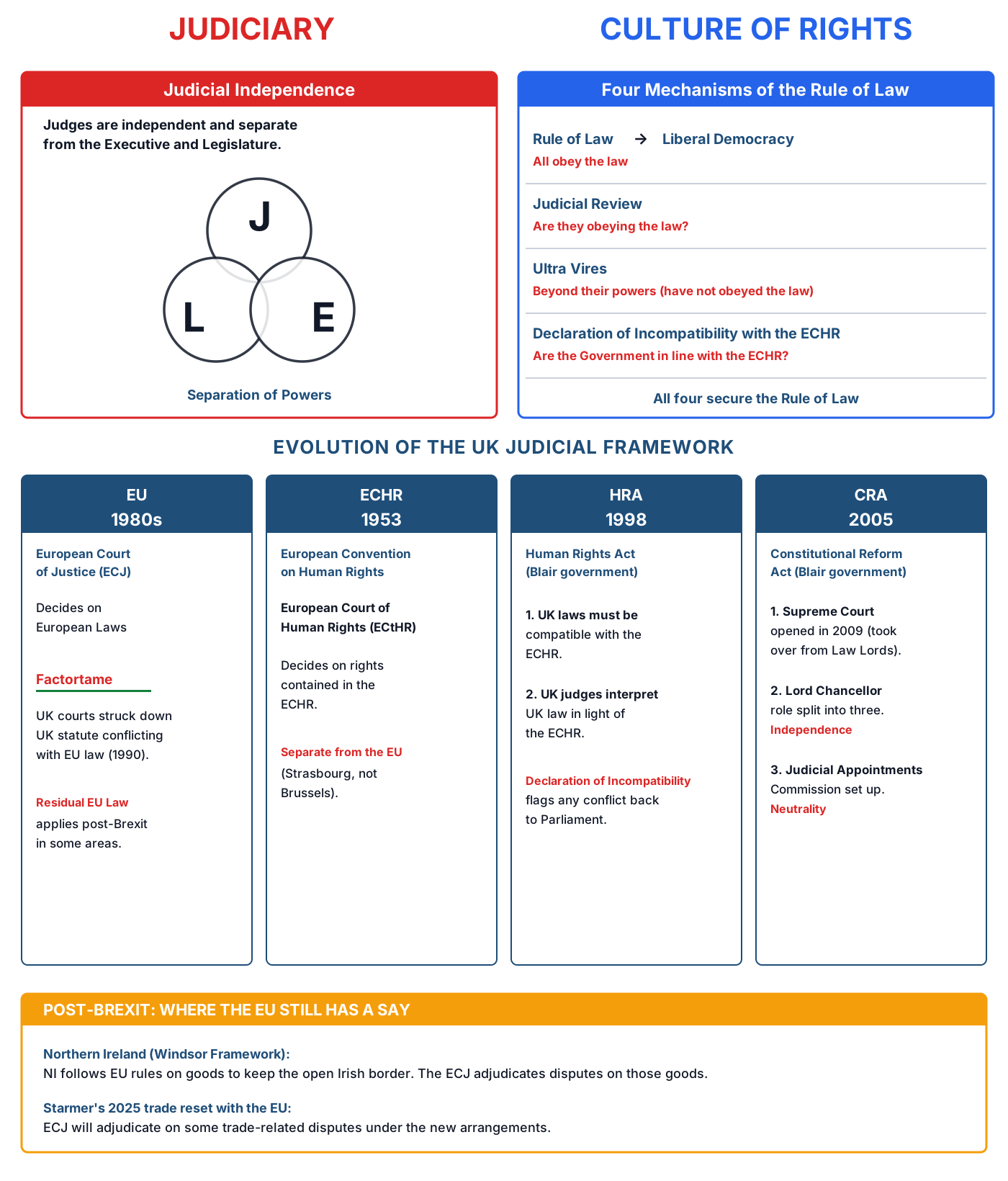
Framework diagram: where the Supreme Court came from
The diagram sets the stage. The Supreme Court did not always exist - it was created by the Constitutional Reform Act 2005 and opened in 2009. The Lord Chancellor's role was split for independence; the Judicial Appointments Commission was set up for neutrality. The HRA 1998 layered the ECHR into UK law before the Court existed. All of this is the framework the "too political" debate runs on.
2. The case FOR (the Court has become too political)
Miller II - prorogation ruling 2019
In Miller II 2019 the Supreme Court ruled Boris Johnson's prorogation of Parliament unlawful. The judgment used the common-law principle of parliamentary sovereignty to limit a prerogative power. Critics including Jonathan Sumption (former Supreme Court justice) argued this was the Court entering political territory - questioning the timing and motivation of an executive decision rather than a clear-cut legal point.
Miller I - Article 50 trigger 2017
The 2017 Miller I case ruled that the government needed parliamentary approval to trigger Article 50. Critics argued this drew the Court into the political process of leaving the EU. Daily Mail headline: 'Enemies of the People' (November 2016 over the Divisional Court ruling, before Supreme Court appeal).
HRA jurisprudence and policy override
Successive judgments under the Human Rights Act have struck down or required modification of government policy on prisoner voting (Hirst v UK 2005), torture evidence, surveillance, deportation. Critics argue these effectively transfer policy authority from elected ministers to unelected judges.
The Sumption critique
Lord Sumption (Reith Lectures 2019, 'Trials of the State') argued the Supreme Court has expanded its role beyond the constitutional design of the CRA 2005. He saw a long-term shift from judicial restraint to judicial activism, with the Court increasingly willing to second-guess political judgments under the cover of legal interpretation.
Devolution rulings
The Court has ruled on Scottish independence-referendum law (2022), Northern Ireland protocol matters, and devolved competence cases. Each draws the Court into politically charged territory where reasonable people disagree.
3. The case AGAINST (the Court is not too political)
Rule-based rulings, not preference-based
In Miller II the Court did not rule on whether prorogation was a good idea. It ruled that prorogation must not frustrate parliamentary sovereignty. The judgment turned on a legal principle, applied consistently. The Court did the same to a Labour government in past cases. Politics is the issues coming before the Court; politics is not the Court itself.
Constitutional Reform Act 2005 created independent Court
The Supreme Court replaced the Appellate Committee of the House of Lords from October 2009. The CRA 2005 was specifically designed to separate the senior judiciary from Parliament and government - a structural shift towards more, not less, neutrality. Justices are appointed by an independent Judicial Appointments Commission, not by political ministers.
Rwanda case 2023
In the Rwanda case the Court ruled that the government's policy was unlawful because Rwanda was not a safe country. Critics called this political; defenders pointed out the Court applied the existing legal test for refoulement and reached a finding of fact based on evidence. The government responded by legislating to declare Rwanda safe by statute - showing that Parliament retains ultimate authority.
Begum case 2024
The Court ruled that Shamima Begum's deprivation of citizenship was lawful, despite arguments about her age and trafficking. This was a politically inconvenient ruling for some on the left and for civil-liberties campaigners. The Court ruling against the campaign-inflected position is evidence that judges follow the law, not political preference.
Judicial appointments are not politicised
Unlike the US Supreme Court where appointments are intensely political, UK Supreme Court justices are appointed via the JAC's merit-based process. Confirmation hearings do not exist. This is structural insulation from political control.
4. Pick a side
The stronger answer is NO - the Supreme Court has not become too political. The political controversy comes from the issues before it (Brexit, prorogation, Rwanda, citizenship deprivation, devolution disputes), not from the Court itself. Sumption's critique is sophisticated but applies more to the Strasbourg court than to the UK Supreme Court. The CRA 2005 structural reforms and the JAC appointment process insulate the Court from political control. Rulings against both Conservative and Labour governments (Miller I+II Conservative; Begum Conservative-era policy upheld) demonstrate consistent rule-based reasoning.
5. Synoptic points (P2 essay - need these for Level 5)
- Pressure groups (1.2): Liberty, Justice, JCWI use judicial review and HRA cases to challenge government. Defenders argue this is pressure groups using courts as designed; critics argue it is pressure groups politicising the courts.
- Voting and turnout (1.4): Public confidence in the judiciary is higher than confidence in Parliament or government (YouGov 2024 - judges 41% trust vs MPs 12%). This complicates the 'too political' claim.
- Parties (1.3): Conservative governments have been more willing to clash with the Court (May, Johnson, Sunak); Labour has historically been more accommodating. Suggests political response, not political court.
- Ideologies: Liberal philosophy (Locke, Mill) values judicial protection of rights; conservative philosophy (Burke, Oakeshott) values evolved tradition over judicial activism; socialist philosophy is split.
6. Writing strategy
Your final judgement
The Supreme Court has not become too political. Politics has come to the Court through the issues; the Court itself remains rule-based and structurally independent.
Strategy
- Pick a side and stick. Open with the line of argument; every paragraph ends with an interim judgement.
- Synoptic points throughout - tie to pressure groups, voting confidence, party stances, ideology. P2 essay caps at L4 without synoptic.
- Thematic structure: appointments / rulings / political response. Each theme weighs both views.
- Use Miller II 2019, Begum 2024, Rwanda 2023, Sumption 2019. Drop pre-2015 examples unless directly relevant.
- Substantiate AO3. Don't assert - explain why each piece of evidence supports your line.