Codification of the UK constitution: more harm than good?
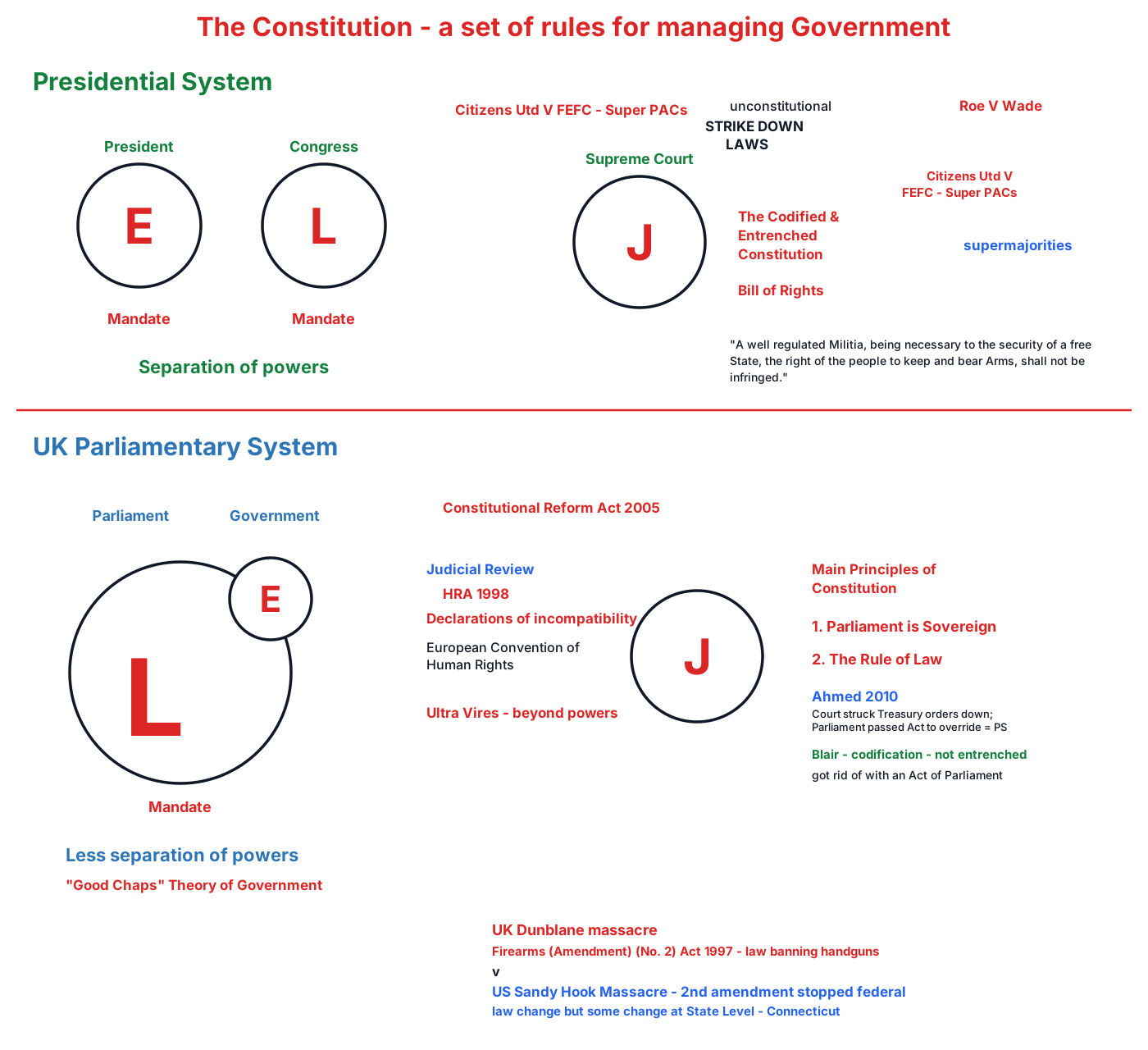
Framework diagram: codified vs uncodified at a glance
The diagram shows the structural contrast the codification essay turns on. US side: three separate branches anchored to a codified and entrenched constitution, with Bill of Rights, supermajority requirements and judicial strike-down (Citizens United, Roe v Wade). UK side: executive nested inside the legislature, judiciary separate, anchored to two principles (parliamentary sovereignty + rule of law); Ahmed 2010 shows Parliament can override a court ruling by Act, the Dunblane vs Sandy Hook box shows how the two systems respond differently to a crisis.
1. Why this question might come up in Summer 2026
The exam board rotates which constitutional debate gets the Q2 essay each year. Codification has not been the central question since 2020. Five years is a long time for the topic to wait, so it is overdue.
Three recent events make codification a strong choice. First, the 2024 Labour government has begun a constitutional reform programme: Lords reform, lowering the voting age to 16, devolved powers expansion. This puts written-constitution debates back on the political agenda. Second, the 2023 Supreme Court ruling on Rwanda showed how the executive can stretch existing constitutional limits when there is no codified bar. Third, the 2025 examiner report flagged that the strongest essay answers used contemporary examples and showed change-over-time, both of which codification questions reward.
This is a Section A 30-mark essay. Marks split AO1 (your knowledge of the codification debate), AO2 (analysis of the arguments), AO3 (a clear judgement). Paper 2 essays carry an extra synoptic clause: no synoptic points = no Level 5. Synoptic points link UK Government content to political participation, parties, voting or ideologies.
2. The case FOR codification (more good than harm)
Legitimacy and clarity
A codified constitution would set out the rules of UK government in a single document that citizens, courts and politicians could read. The current uncodified constitution is scattered across statute (Magna Carta 1215, Bill of Rights 1689, Parliament Acts 1911 and 1949, the European Communities Act 1972, the Human Rights Act 1998, the Constitutional Reform Act 2005, the Fixed-term Parliaments Act 2011 - now repealed, the Brexit-era statutes), common law, conventions and authoritative texts. The 2019 Supreme Court ruling against Boris Johnson on prorogation showed how courts must reach for common-law principles in the absence of a written rule. A codified constitution would make the rules visible and accessible, reducing the legitimacy gap between government and governed.
Rights protection
The Human Rights Act 1998 is statute, not constitutional law. A future Parliament can repeal or replace it - the 2022 Conservative Bill of Rights Bill attempted this. Successive governments have considered scrapping the HRA. Under a codified constitution, fundamental rights would be entrenched and only changeable by a special procedure (e.g. two-thirds majority of both Houses, or referendum approval). This is the protection model the United States, Germany, Canada and Ireland use. The 2024 Begum case and the Rwanda Bill 2023 both highlighted how the lack of constitutional rights protection allows politically-driven legislation to override settled principles.
Constraint on executive overreach
The 2019 prorogation case (Miller II) showed that the executive can stretch constitutional limits when only conventions stand in the way. Boris Johnson's prorogation was ruled unlawful only after the Supreme Court reached for the common-law principle of parliamentary sovereignty. A codified constitution would set out clearly what the Prime Minister can and cannot do with prerogative powers. The 2023 Rwanda Bill explicitly told courts not to apply the HRA to certain decisions - a move that would be much harder under a codified system with entrenched judicial review.
Devolution settlement
The current devolution settlement is a patchwork: Scotland, Wales and Northern Ireland have different powers under separate Acts. The 2014 Scottish independence referendum and the 2016 Brexit vote raised hard questions the uncodified constitution could not cleanly answer. A codified constitution could lock in devolution as a structural feature of the state, removing the threat of a future Westminster government simply legislating it away.
Synoptic link - voting and democratic participation
Public confidence in the political system is at a low point - YouGov polling in early 2026 placed trust in Westminster at a record low. Codified constitutions in Germany and Ireland are linked to higher democratic legitimacy and participation rates. A written constitution that citizens could read would help close the legitimacy gap.
3. The case AGAINST codification (more harm than good)
Flexibility and adaptation
The UK's uncodified constitution adapts continuously without the need for elaborate amendment procedures. Devolution to Scotland, Wales and Northern Ireland in 1997-99 took simple Acts of Parliament. Brexit was achieved through legislation. The Constitutional Reform Act 2005 created the Supreme Court and reformed the Lord Chancellor's role through ordinary statute. Compare with the United States, where constitutional amendments require two-thirds of Congress plus three-quarters of state legislatures - it has not happened on a substantive issue since 1971. UK reform is faster.
Sovereignty of Parliament
A codified constitution by definition limits parliamentary sovereignty - the principle that no Parliament can bind its successor. Under codification, an entrenched constitution would override ordinary legislation. This is a major break with the Diceyan tradition. Critics argue this transfers power from elected MPs to unelected judges who interpret the constitution. The US Supreme Court's overturning of Roe v Wade in 2022 showed how constitutional courts can deliver politically contentious rulings unaccountable to voters.
Politicisation of the judiciary
A codified constitution makes the judiciary the ultimate constitutional authority. Senior judges become political actors. The US example is instructive: appointments to the Supreme Court are now intensely political, with confirmation hearings dominated by ideological fights (Kavanaugh 2018, Barrett 2020, Jackson 2022). Critics argue codification would import this politicisation into the UK system.
Working flexibility - Lords reform under Starmer
The 2024 Labour government has begun reform of the House of Lords - removing remaining hereditary peers. This is being done through ordinary legislation. Under a codified constitution that entrenched the bicameral structure, such reform would require a constitutional amendment. The flexibility of the uncodified system allows incremental modernisation.
Synoptic link - parties and ideologies
Conservative ideology specifically values traditional, evolved institutions over abstract designed ones. Edmund Burke's argument that constitutions are 'partnerships between past, present and future generations' resists codification. The Conservative Party's 2022 Bill of Rights proposal would have weakened, not codified, rights protection - illustrating the political vulnerability of a 'codified' constitution to partisan rewriting.
4. Pick a side. No fence-sitting.
Edexcel mark schemes and examiner reports are clear: top-band answers commit to one side and defend it. Answers that fence-sit are capped at Level 3.
The stronger answer is that codification would do MORE GOOD than harm. The flexibility argument is real but the cost - rights vulnerability, executive overreach, devolution insecurity - is now too high. The Rwanda case and the 2022 Bill of Rights attempt show how a future government can simply rewrite the rules. Parliamentary sovereignty served the UK well in stable times but has become a vulnerability in an era of populism and rapid policy change. Codification with a moderate amendment threshold (not the US two-thirds super-majority) would deliver legitimacy and rights gains without the rigidity critics fear.
5. Synoptic points (P2 essay needs these for Level 5)
Paper 2 essays cap at Level 4 if there are no synoptic points. Codification synoptic links:
- Voting and turnout (1.4): Codified constitutions correlate with higher democratic legitimacy in cross-country studies. UK turnout fell to 60% in 2024 - the lowest since 2001. Constitutional reform is sometimes argued as a route to higher engagement.
- Political parties (1.3): Conservative ideology resists codification (Burke); Liberal Democrats consistently support it (party manifestos 2010-24); Labour has shifted towards constitutional reform under Starmer (Lords, voting age, devolution).
- Ideologies (Section B link): Conservatism (Oakeshott, Burke) values evolved tradition; liberalism values codified rights (Locke, Mill); socialism is split (Marxist scepticism of bourgeois constitutions vs social-democratic codified rights).
- Pressure groups (1.2): Liberty, the Joseph Rowntree Reform Trust, the Constitution Society have campaigned for codification. The Joint Committee on Human Rights is a parliamentary version of this advocacy.
6. Writing strategy
Your final judgement
Codification would do more good than harm. Rights protection, executive constraint and devolution security outweigh the loss of flexibility. The 2022 Bill of Rights attempt and the 2023 Rwanda Bill show the cost of leaving rights as ordinary statute.
Essay strategy
- Pick a side and stick to it. Open the essay with the line of argument. Every paragraph ends with an interim judgement that lands on this side.
- Synoptic points throughout. Do not save synoptic links for the conclusion - weave them into each paragraph. Tie codification to voting reform, party stances, ideology, pressure-group campaigns.
- Thematic structure. Three themed paragraphs work well: (1) rights protection, (2) executive constraint, (3) flexibility vs entrenchment. Each theme has both views weighed and an interim judgement on your side.
- Contemporary examples. Use Rwanda Bill 2023, Lords reform 2024-25, voting-age change, Begum 2024. Drop pre-2015 examples unless directly relevant.
- Substantiated AO3. Don't just assert that codification is better - explain why each piece of evidence supports the line. Mark scheme phrases to deploy: 'fully focused and justified conclusions', 'consistently substantiated', 'sustained, logical chains of reasoning'.