Executive dominance of Parliament · Notes + essay plan
Essay plan
- Government majority + whip system. Blair 1997 (179), Johnson 2019 (80), Starmer 2024 (411 seats / 174 majority). With these majorities the government wins almost every vote.
- Standing Order 14. Government business gets priority. The government controls the parliamentary timetable.
- Salisbury Convention. Lords does not block manifesto bills; reduces the upper-chamber check.
- Secondary legislation explosion. Statutory instruments made by ministers under wide enabling Acts. EU (Withdrawal) Act 2018 gave very wide Henry VIII powers. Post-Brexit hundreds of SIs each year with weaker scrutiny than primary legislation.
- Select committees. Home Affairs Select Committee 2018 (Yvette Cooper) forced Amber Rudd's resignation. The Liaison Committee questions the PM. Reports drive media coverage and policy retreat.
- Backbench rebellions. May lost three Brexit votes 2018-19. Truss mini-budget 2022 - markets, Cabinet, and party combined to force her out in 49 days. Starmer welfare rebellions 2025.
- Lords as revising chamber. Often forces government concessions even when it cannot block.
- Judicial review. Miller 1 (Article 50) and Miller 2 (prorogation) reinforced parliamentary sovereignty against executive overreach.
- A government with a big majority (Blair 1997, Johnson 2019, Starmer 2024) DOES dominate Parliament in practice.
- A government with a small or no majority (Major 1997 last months; May 2017-19; minority-style situations) does NOT - Parliament reasserts itself.
- The "elective dictatorship" thesis is most accurate during big-majority governments and least accurate during hung or coalition periods.
Conclusion. Yes, the executive dominates Parliament substantially - the structural tools (majority, whips, Standing Order 14, secondary legislation) are real and have grown since 1979. But dominance is conditional on majority size, party unity, and Lords cooperation; under hung parliaments, large rebellions, market collapse or judicial review the executive's dominance breaks down. The strongest verdict: the structure tilts toward executive dominance but contains regular self-correcting mechanisms.
The elective dictatorship in one picture
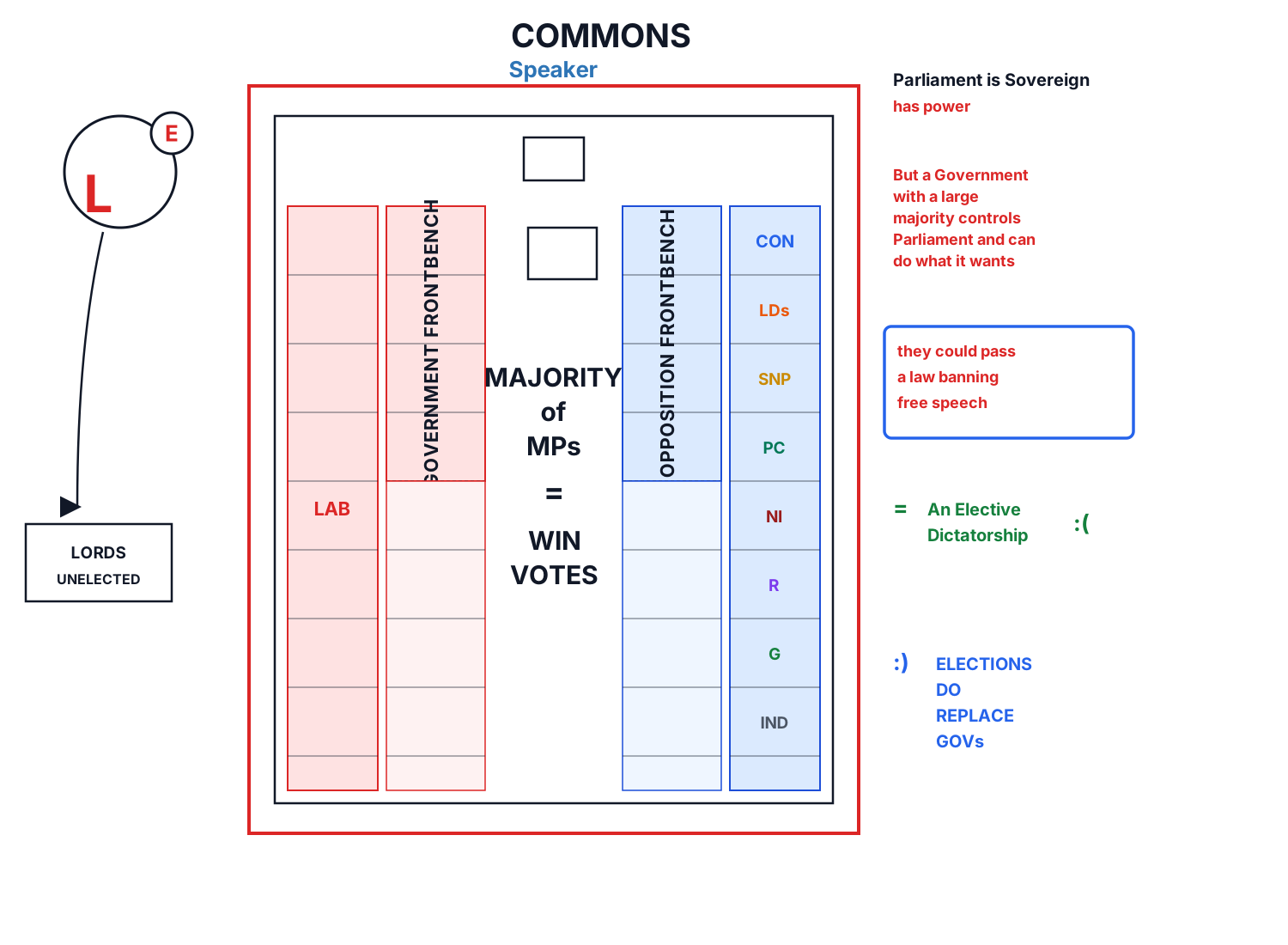
The Commons chamber layout below is the visual the essay turns on. A majority of MPs wins votes. Parliament is sovereign. A Government with a large Commons majority therefore controls Parliament and can pass any Act it likes - the operational definition of elective dictatorship. The safety valve - elections do replace governments - sits to the bottom right. The essay's argument hinges on whether that safety valve is enough.
1. Elective dictatorship - Hailsham's concept
The phrase elective dictatorship was coined by Lord Hailsham (Quintin Hogg) in his 1976 Richard Dimbleby lecture, while in opposition to Wilson's Labour government. Hailsham's argument: a UK government with a strong Commons majority faces almost no constitutional check between elections. It can pass any law it wants. The "dictatorship" is "elective" only in that it depends on winning the next election - between elections it is essentially unconstrained.
The phrase has become a standard shorthand for the executive-dominance thesis. It captures three features in one:
- The fused executive-legislature - the government IS the parliamentary majority.
- The absence of strong checks (no codified constitution, weak second chamber, no constitutional court that can strike down statutes).
- The five-year electoral cycle as the only real accountability.
2. The tools of executive dominance
Government majority + whip system
The single biggest tool. A government with a working majority wins almost every Commons vote. Whips enforce party discipline through career incentives (promotion to ministerial office) and party sanctions (withdrawal of whip).
- Blair 1997: 179-seat majority. Iraq War passed despite Labour rebellions.
- Johnson December 2019: 80-seat majority. Withdrawal Agreement Bill passed.
- Starmer July 2024: 174-seat majority on 411 seats. Substantial legislative power.
Standing Order 14
Government business has priority on parliamentary time. The government controls when Bills are debated, how long, and whether amendments are taken. Opposition has limited days, and Private Members' Bills face significant procedural barriers. SO14 was tested during Brexit when Speaker Bercow allowed opposition control of the order paper - controversial and unusual.
Salisbury Convention
The convention that the House of Lords does not block legislation that was in the governing party's election manifesto. Named after the 1945 agreement between Labour and the Conservatives. Reduces the second-chamber check on flagship legislation. Lords still amends but does not block at second or third reading.
Secondary legislation explosion
Acts of Parliament increasingly contain "Henry VIII powers" allowing ministers to amend primary legislation by statutory instrument. The EU (Withdrawal) Act 2018 is the most-cited example - very wide powers to amend retained EU law by SI. SIs are subject to less parliamentary scrutiny than Bills (typically the negative or affirmative resolution procedure rather than line-by-line consideration). Hansard Society and Lords Constitution Committee both flagged this as a serious democratic concern post-2018.
Cabinet collective responsibility + PM appointments
The PM appoints and dismisses Cabinet ministers. Collective responsibility means ministers must publicly support government policy or resign. This insulates government policy from internal critique - dissenting ministers must leave the room. Robin Cook 2003 resigned over Iraq; Sajid Javid + Rishi Sunak July 2022 resigned and triggered Johnson's downfall.
3. The checks that do still bite
Select committees
The post-1979 reforms made select committees politically significant. They scrutinise individual departments and increasingly drive media coverage and policy concessions.
- Home Affairs Select Committee 2018 - Yvette Cooper chair. Sustained pressure following the Windrush scandal forced Amber Rudd's resignation as Home Secretary.
- Liaison Committee - chairs of all select committees question the PM twice a year. High-profile sessions.
- Public Accounts Committee - scrutinises government spending and value for money.
Backbench rebellions
Even strong-majority governments can be defeated by their own MPs. The Conservative party's Brexit-era splits show this clearly.
- Theresa May lost three Brexit deal votes January-March 2019, including the largest government defeat in modern parliamentary history (432-202).
- Truss mini-budget September 2022 collapsed after Cabinet, party and market all turned against it.
- Starmer welfare cuts 2025 faced Labour backbench rebellion; partial concessions made.
House of Lords as revising chamber
The Lords cannot indefinitely block Commons legislation (Parliament Acts 1911, 1949) but routinely forces amendments. The Rwanda Act 2024 saw extensive Lords amendments though the government ultimately got its core provisions through. The Hereditary Peers Act 2024 reforming the Lords itself shows the chamber is also subject to change.
Judicial review
Miller 1 and Miller 2 are the contemporary cases. Other significant ones: UNISON v Lord Chancellor (2017) - employment tribunal fees struck down; R (Begum) citizenship deprivation case 2021 - upheld but established the framework.
Market reaction
Not a constitutional check but a real one. Truss mini-budget September 2022 - bond markets, pension funds, currency all collapsed within days. The PM was forced out within seven weeks. Markets disciplined an "elective dictatorship" the parliamentary system would not have removed so quickly.
4. PMs compared - majorities and rebellions
| PM | Majority | Dominance / rebellion balance |
|---|---|---|
| Blair 1997-2007 | 179 then 167 then 66 | High dominance early; Iraq 2003 generated big Labour rebellions (139 against); forced out 2007. |
| Brown 2007-10 | Inherited Blair majority but minority-feel | Less dominance; subject to bigger Labour internal pressures; lost 2010. |
| Cameron / coalition 2010-15 | Coalition - no single party majority | Reduced dominance; Lib Dems checked Cons; lost 2013 Syria vote. |
| Cameron majority 2015-16 | 12-seat majority | Limited dominance; lost 2016 EU referendum and resigned. |
| May 2017-19 | Lost majority in 2017 election; minority + DUP confidence and supply | Very low dominance; lost three Brexit votes; forced out 2019. |
| Johnson 2019-22 | 80-seat majority | High dominance Dec 2019 - early 2022; then Partygate, Cabinet revolt July 2022. |
| Truss 2022 | Inherited Johnson majority | Theoretical dominance ended in 49 days by markets, Cabinet, and party. |
| Sunak 2022-24 | Inherited Johnson majority | Moderate dominance; Rwanda Act rebellions; lost 2024 election. |
| Starmer 2024- | 174-seat majority on 411 seats | Currently high dominance; welfare rebellions 2025 showing limits. |
5. Exam traps and high-band moves
The trap most students fall into
Either treating executive dominance as a fixed constitutional fact (without recognising it depends on majority size) OR listing checks without acknowledging the underlying structural dominance. Both miss the central comparative move.
High-band moves
- Cite Lord Hailsham 1976 and the elective-dictatorship concept by name and date.
- Use the EU (Withdrawal) Act 2018 + Henry VIII powers as the strongest contemporary executive-dominance example - it is structural not just political.
- Use the May 2018-19 period as the strongest counter-example - Parliament reasserted itself completely.
- Use Miller 1 and Miller 2 as the courts-as-limit cases.
- Acknowledge the EU exit removed an external check while internal checks have evolved (more select committee power, more Lords expertise post-2024 hereditary peer removal).
- Reach a clear comparative judgement - dominance is real but conditional.