The presidential PM thesis · Notes + essay plan
Essay plan
- Media focuses on the PM as the embodiment of government - Thatcher's "lady's not for turning", Blair's "we're at our best when we're at our boldest", Johnson's bus and the "oven-ready deal".
- General elections are increasingly fought as PM vs Leader of Opposition contests - 2019 Johnson vs Corbyn, 2024 Sunak vs Starmer.
- BUT: Truss 2022 collapse showed personality is not enough - she lasted 49 days. Personality without political capital is fragile.
- Growth of SPADs and the No 10 policy machine. Blair's "sofa government"; Cummings under Johnson 2019-20; Liz Truss / Kwasi Kwarteng mini-budget Sept 2022 bypassed the OBR and the Treasury orthodoxy.
- PM dominates the appointment process - cabinet selection, reshuffles, peerage nominations.
- BUT: Cabinet revolts and resignations still happen. Johnson lost his Cabinet July 2022 after the Pincher scandal - 50+ resignations in 48 hours forced him out. The presidential PM can be removed by the Cabinet and the parliamentary party.
- PMs dominate foreign policy and war-making decisions. Blair-Iraq 2003; Cameron-Libya 2011; Johnson-Ukraine 2022; Sunak-Israel-Gaza 2023; Starmer-Iran response 2025.
- BUT: Cameron lost the 2013 Syria vote - Parliament can refuse military action. Royal prerogative is not unconstrained.
- The US President's formal powers (commander-in-chief, executive orders, veto, appointments to lifetime SCOTUS positions) have NO direct UK equivalent. The presidential analogy is rhetorical not constitutional.
Conclusion. The presidential PM thesis captures something real - the centralisation of media attention and No 10 power. But the constitutional architecture (fused executive-legislature, parliamentary sovereignty, judicial review, party discipline at both ends, no fixed term, no Bill of Rights) prevents full presidentialism. The strongest verdict: PM has presidential FEATURES but operates within parliamentary structures that periodically reassert themselves - Truss collapse, Johnson removal, Miller 1 and 2 all show the limits.
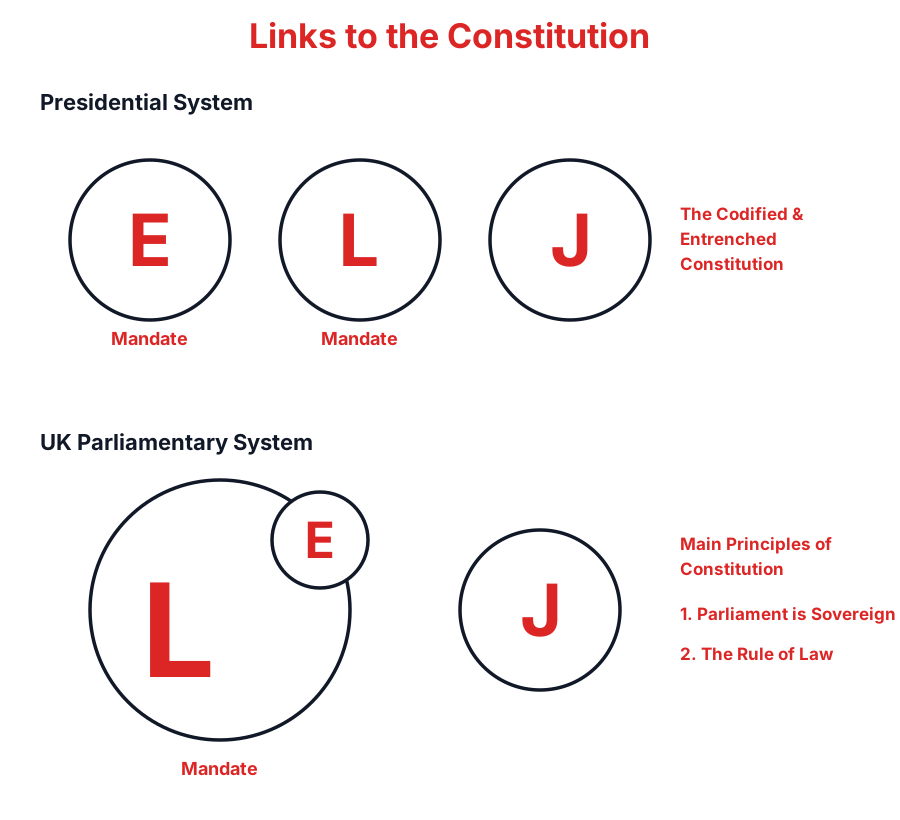
Why the PM is not structurally a President
The diagram shows the structural counter that runs through this essay. In a presidential system the Executive (E), Legislature (L) and Judiciary (J) are three separate circles, each with its own democratic mandate. In the UK parliamentary system the Executive sits INSIDE the Legislature. The PM is not elected as PM; the PM is the leader of the majority party in the Commons. That structural fact is the foundation of every "no, the PM is not a President" argument in the essay.
1. The presidential PM thesis - what it means
The presidential PM thesis is associated with Michael Foley (The Rise of the British Presidency 1993; The British Presidency 2000) and was sharpened by commentators describing Blair's premiership 1997-2007. The argument: the UK PM has accumulated features that make the office resemble a US-style presidency without the formal constitutional move.
The features Foley identified
- Spatial leadership - the PM standing apart from the party, governing as a national figure rather than as primus inter pares (first among equals).
- Personalisation - politics organised around the PM as a personality rather than around the party or the Cabinet.
- Centralisation - power concentrated in No 10 and the PM's office, with growth of SPADs, policy units, and direct PM-to-department contact.
- Foreign policy dominance - the PM as the visible face of UK foreign engagement.
- Media-driven leadership - the PM as the primary subject of news coverage and political debate.
2. Evidence FOR the presidential reading
Personalisation in elections
UK general elections increasingly resemble presidential contests. 1979 Thatcher vs Callaghan; 1997 Blair vs Major; 2019 Johnson vs Corbyn; 2024 Sunak vs Starmer. TV debates since 2010 reinforce the leader-on-leader format. Manifestos are often described as "Blair's manifesto" or "Starmer's plan" rather than as Labour or Conservative collective products.
Centralisation in No 10
The PM's office has grown substantially. The number of Special Advisers (SPADs) attached to No 10 has grown from a handful under Wilson to over 100 under Johnson and Starmer. The Cabinet Office Implementation Unit and the Policy Unit give the PM direct policy-making capacity that bypasses departments. Blair's "sofa government" in the late 1990s and 2000s formalised the trend; Cummings under Johnson 2019-2020 took it further with the explicit attempt to centralise power in No 10 and weaken the Treasury.
Foreign policy dominance
The PM has become the visible UK figure on foreign and defence policy. Blair's decision to commit UK forces to Iraq 2003 was substantially a PM decision (though Parliament voted on it). Cameron-led Libya intervention 2011. Johnson as the lead Western supporter of Ukraine 2022. Sunak response to Israel-Hamas 2023. Starmer handling of UK-Iran tensions 2025. PMs increasingly conduct summit diplomacy and act as the face of UK foreign policy.
The bypassing of Cabinet government
Cabinet has become less of a deliberative body and more of an information-sharing meeting. Major decisions are often taken in bilateral discussions between the PM and the relevant Secretary of State, or in informal "kitchen cabinet" settings. Blair's pre-Iraq Cabinet meetings were criticised as too short and information-light; Truss's mini-budget bypassed full Cabinet discussion.
3. Evidence AGAINST - the structural counter
Parliamentary sovereignty constrains
The PM operates within parliamentary sovereignty in ways no US President does. The PM is a member of Parliament. The government depends on a Commons majority. Major legislation must pass both chambers (subject to Salisbury Convention). When the parliamentary arithmetic breaks, the PM falls - May lost three Brexit votes and resigned 2019; Truss lost market confidence and her own party Oct 2022.
Cabinet and party can remove the PM
Unlike a US President, a UK PM can be removed by their own party mid-term. Thatcher resigned 1990 after losing the first round of a leadership contest. Major faced a leadership challenge 1995. Blair was forced out by Brown faction 2007. Cameron resigned post-Brexit 2016. May resigned 2019. Johnson resigned July 2022 after Cabinet revolt. Truss removed Oct 2022 after 49 days. The PM is removable in ways no US President is between elections.
Judicial review and courts constrain
Miller 1 (2017) and Miller 2 (2019) showed the Supreme Court can constrain executive action. Miller 1: Article 50 requires an Act of Parliament, not executive prerogative. Miller 2: prorogation of Parliament for 5 weeks was unlawful, void and of no effect. Both rulings reinforced the limits of presidential-style executive action.
The Cameron Syria vote 2013
August 2013: Cameron asked the Commons to authorise UK military strikes in Syria. The Commons voted 285-272 AGAINST. Cameron immediately accepted the result and abandoned military action. This is the clearest modern example of Parliament constraining a PM on the most prerogative-style power - war-making. No US President has been blocked by Congress on a comparable decision.
Internal party constraint
The PM is the leader of the party AND depends on the party's tolerance. Backbench rebellions can force U-turns. May's three Brexit defeats 2018-19. Johnson's 41% no-confidence vote June 2022. Sunak's Rwanda Act rebellion attempts 2023-24. Starmer-era cuts and welfare rebellions 2025.
4. Comparative PMs - Thatcher to Starmer
Each modern PM has shown some presidential features and some parliamentary constraints. The pattern is uneven, not a one-way ratchet.
| PM | Presidential features | Constraints that bit |
|---|---|---|
| Thatcher 1979-90 | Personality dominance, "Iron Lady", strong centralisation, big-beast cabinet ministers progressively removed. | Removed by her own party Nov 1990 after Howe resignation speech, Heseltine leadership challenge. |
| Blair 1997-2007 | Sofa government, large majorities (179 in 1997), foreign policy dominance Iraq 2003, media focus. | Forced out by Brown faction 2007; Iraq damaged authority; Labour rebellions on Iraq 2003. |
| Cameron 2010-16 | Coalition leader 2010-15; media focus; foreign policy summits. | Lost 2013 Syria vote in Commons; lost 2016 EU referendum; resigned. |
| May 2016-19 | Strong initial Brexit framing. | Lost 2017 election majority; three Brexit defeats; forced out. |
| Johnson 2019-22 | 80-seat majority Dec 2019; Cummings centralisation; personal media dominance. | Cabinet revolt July 2022 (50+ resignations); Partygate; removed by his own party. |
| Truss 2022 | None - too short to develop. | Lasted 49 days; mini-budget collapse; market revolt; removed by her own party. |
| Sunak 2022-24 | Personal control of policy and SPAD-heavy No 10. | Lost 2024 election; party rebellions on Rwanda. |
| Starmer 2024- | 411-seat majority gives strong presidential platform; foreign policy lead role (Iran 2025, Ukraine support). | Internal Labour rebellions on welfare cuts 2025; falling approval; party tensions. |
5. Exam traps and high-band moves
The trap most students fall into
Writing the essay as "list of presidential features" without engaging the constitutional structure that prevents presidentialism. Capped at L3 unless you address the parliamentary-sovereignty / cabinet / party / court counter.
High-band moves
- Cite Michael Foley's presidential thesis by name and date (1993/2000).
- Distinguish behavioural presidentialism (real) from constitutional presidentialism (absent).
- Use TWO contrasting PMs (e.g. Blair as most presidential; Truss as least) to show variation.
- Use Miller 1 and 2 as the courts-as-limit cases.
- Use the 2013 Syria vote as the Parliament-as-limit case.
- Reach a clear interim judgement on each theme - do not just hedge.
- Acknowledge that EVEN within the parliamentary system the PM has become more dominant - the comparison is to the past UK PM, not to the US President.